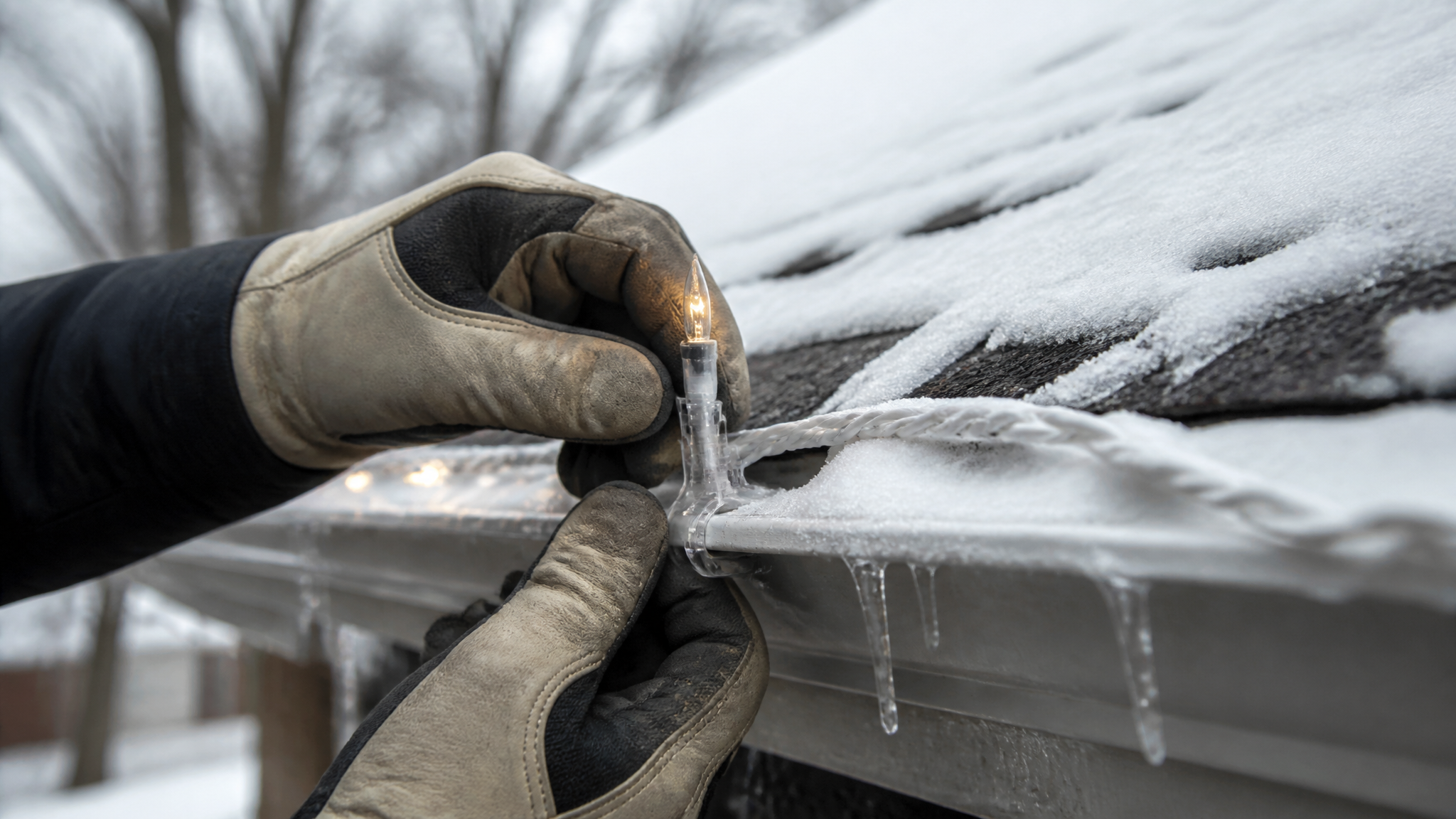
For a single-story ranch with a straight roofline, DIY is reasonable. For anything two stories or steeper in Michigan, the January takedown is the part that gets people hurt. Here's how to decide.
**If your house is a single story with a straight, accessible roofline, hanging your own holiday lights is a reasonable weekend project. If it is two or more stories, has a steep pitch, or requires reaching over a lower roof, the honest answer in Michigan is no - and the reason is not the install, it is the takedown in January.** Going up in October on dry shingles in fifty-degree weather is the easy half. Coming down in January on iced shingles in the cold and the wind, with the novelty gone and daylight ending at 5pm, is where people fall.
That is the decision, and it is worth making deliberately rather than by default.
When is DIY holiday lighting genuinely fine?
Do it yourself if most of these are true:
- **One story, or a low second story you can reach from a stable ladder position on level ground.**
- **A straight, simple roofline** - one or two runs, no dormers, no plane transitions.
- **A modest scope.** Roofline and maybe a wreath. Not columns, canopy wraps, and tree work.
- **You own decent equipment** and are comfortable on a ladder.
- **You will actually take them down.** In February, not in April.
Under those conditions DIY costs less, and the result can look good - especially if you buy commercial-grade strand instead of the cheapest retail box, measure your runs, and use proper clips rather than staples.
When should you hire it out in Michigan?
Hire it out if any of these are true:
**Your house is two or more stories.** The failure mode on a fall from that height is severe, and every year emergency departments see a wave of holiday-decorating falls. This is the single clearest line.
**Your roof has a steep pitch.** Pitch turns a stable surface into a slide, and it does so faster once there is frost.
**You need to reach over a lower roof.** Setting a ladder on a porch or garage roof to reach a second-story run is one of the more common ways this goes badly.
**You want a complex design.** Multiple gables, dormers, plane transitions, columns, garland, and trees. This is where the gap between a professional install and a DIY install is most visible from the street - the transitions and the spacing are what make it read as intentional.
**You are past mid-November.** In West Michigan, lake-effect snow can put four to six inches on your roof while inland Michigan is still dry. Once there is snow and ice on the shingles, a DIY install stops being a project and becomes a genuine risk.
**You would not enjoy the January takedown.** Be honest here. Ask anyone who has done it twice.
Is it the height or the ice that's the real risk?
**The ice, and it is why the takedown is the dangerous half of the job.** October installs happen on dry shingles in decent weather with good light and fresh motivation. January takedowns happen on shingles that have been through freeze-thaw cycles, in the cold, in the wind, with less daylight, on a job nobody wants to be doing.
This is also why "I'll just leave them up until spring" is such a common outcome - and why so many Michigan houses have a strand still up in April. Leaving them up is the safest DIY choice available in January, which tells you something about the alternative.
What does a professional install actually get you?
Beyond the obvious "you are not on the roof":
- **Custom-cut strands.** Measured and cut to your specific runs, so spacing is even and the ends land where they should. This is the main reason a professional install looks different from the street.
- **Clip attachment, no holes.** No staples, no nails, no adhesive on your trim or fascia.
- **Commercial-grade product.** Strand, clips, and sealed connections rated for wind and snow load, not for a mild afternoon.
- **In-season service.** A section goes dark in December, someone else fixes it.
- **Takedown and storage.** January into February, and your labeled strands are stored off-site - not in your garage, and not up until April.
- **Year two is easier.** Your set already fits your house, so the next install is a re-hang.
What about permanent lighting instead?
**Permanent LED lighting removes the DIY question permanently, which is why a lot of Michigan homeowners end up there.** It is a fixed channel installed under the eave, controlled from your phone, that stays year-round and is invisible in daylight. No annual install, no January takedown, no ladder, ever. And because it does twelve months of work - warm white as the standing look, holiday colors in December, orange in October, team colors for a game - it stops reading as a seasonal expense.
For a two-story Michigan house whose owner is quietly dreading January, it is often the actual answer to the question in this post's title.
The short version
One story, simple roofline, and you will genuinely take them down in February: DIY away. Two stories, steep pitch, complex design, or a honest reluctance about January: hire it out or go permanent. The install is not what gets people. The takedown is.
**Not sure which side of the line your house falls on?** We will tell you straight. Free on-site design consultations across West Michigan - Grand Rapids, East Grand Rapids, Ada, Cascade, Rockford, Holland, and Grand Haven. Call **(616) 952-4644**.